An Irish terroir, a French know-how
Know-how
The oysters of La Famille Boutrais start as French spat, grow to the half-reared stage in Clew Bay, and are then graded and sent to the house's terroirs according to the quality sought. Ostra Regal and Sentinelle are refined in the conche: eighteen to twenty-four months in a land-locked bay, at two oysters per square metre.
From spat to basket
It all begins with the selection of French spat, sent to our farm in Clew Bay. Our teams tend them there up to the half-reared stage, about eighteen months. The batches are then graded and sent to our various grounds to finish growing, according to the range we want to obtain. Our traceability is duly tracked at every step.
The conche, a giant natural claire
A conche is a natural bay enclosed by land, linked to the sea by a very small mouth, and yet subject to the tides. It holds fresh water and nutrients: there the oyster grows very fleshy. It works like a giant claire that nature drew on its own.
Our oysters are refined in the conche for eighteen to twenty-four months, in extensive farming: two oysters per square metre.
From the house's catalogue
Conche and bay: two environments, two oysters
Watch the tide uncover the beds, and the rivers feed the bay.
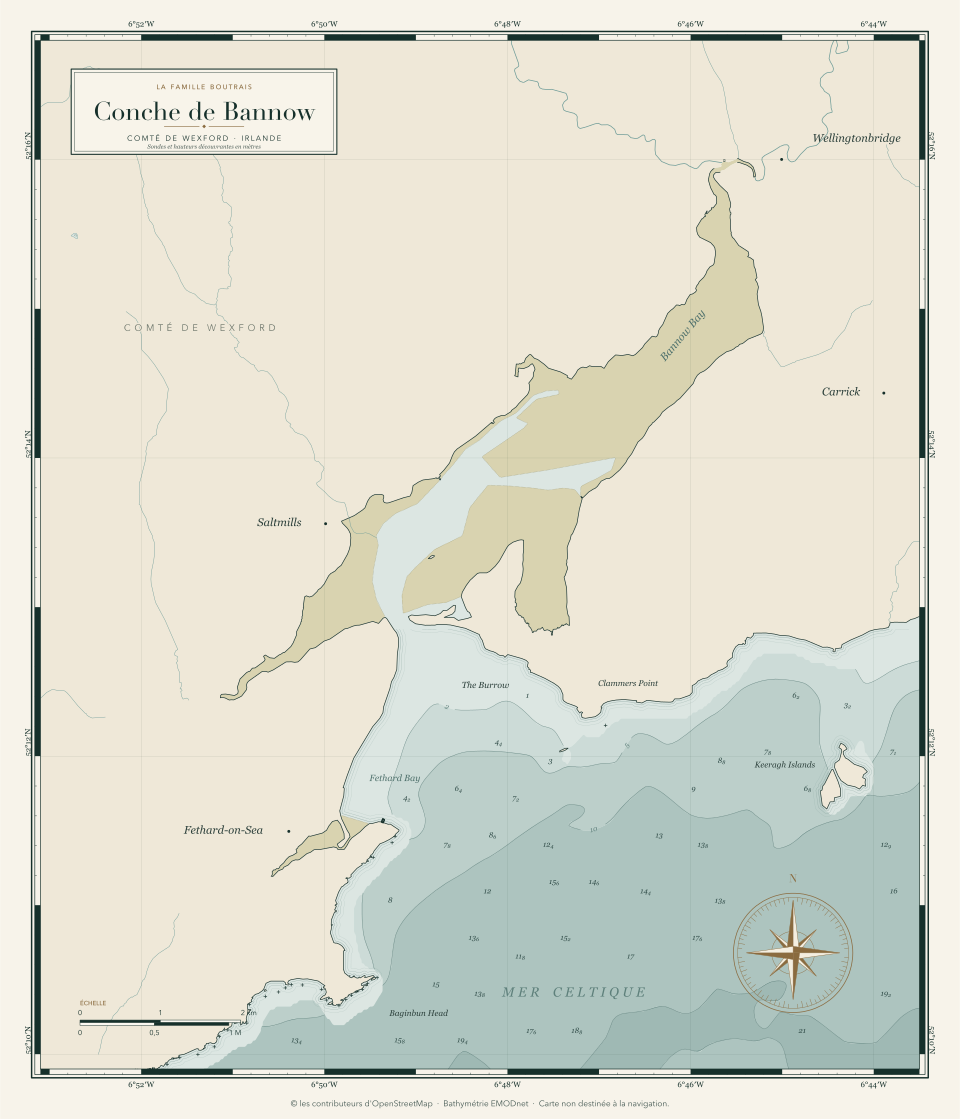
- Nutrients carried in by the rivers
- Open-sea water (rising tide)
- The house's oyster beds
The Bannow conche
A bay enclosed by land, linked to the sea by a very small mouth.
- It empties entirely at low tide and fills entirely at high tide, whatever the tidal coefficient.
- It is supplied with fresh water by rivers and streams, which deposit nutrients in it.
- The salt level there is very low, and it is that factor which gives the oysters their sweetness.
- The oysters are handled on the high ground, to obtain slow growth.
- The farming density is 2 oysters per square metre.
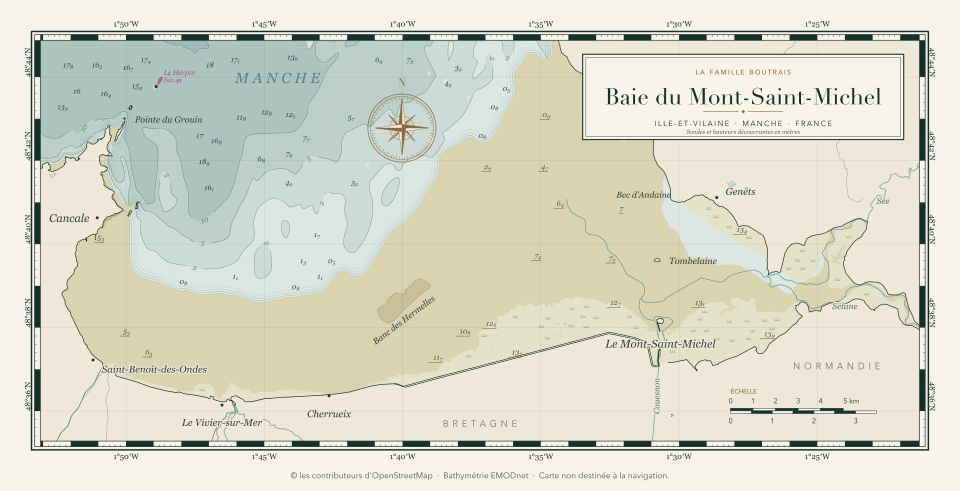
- Nutrients carried in by the rivers
- Open-sea water (rising tide)
- The house's oyster beds
The bay of Mont-Saint-Michel
A bay surrounded by land, but open to the sea.
- 23 km separate the two ends of the bay.
- It is fed with fresh water by 3 rivers that flow in at the same place.
- Plankton is brought in by the tidal currents and the natural outflow of the rivers.
- The oysters there are worked close to the shore.
Charts drawn by the house from OpenStreetMap and EMODnet — not for navigation.
By hand
Each oyster is handled more than sixty times, to restrain the growth of the shell and favour fattening. Two tides a day leave the beds fully exposed: the oyster stays closed twelve hours out of twenty-four, which refines its taste and hardens its shell.
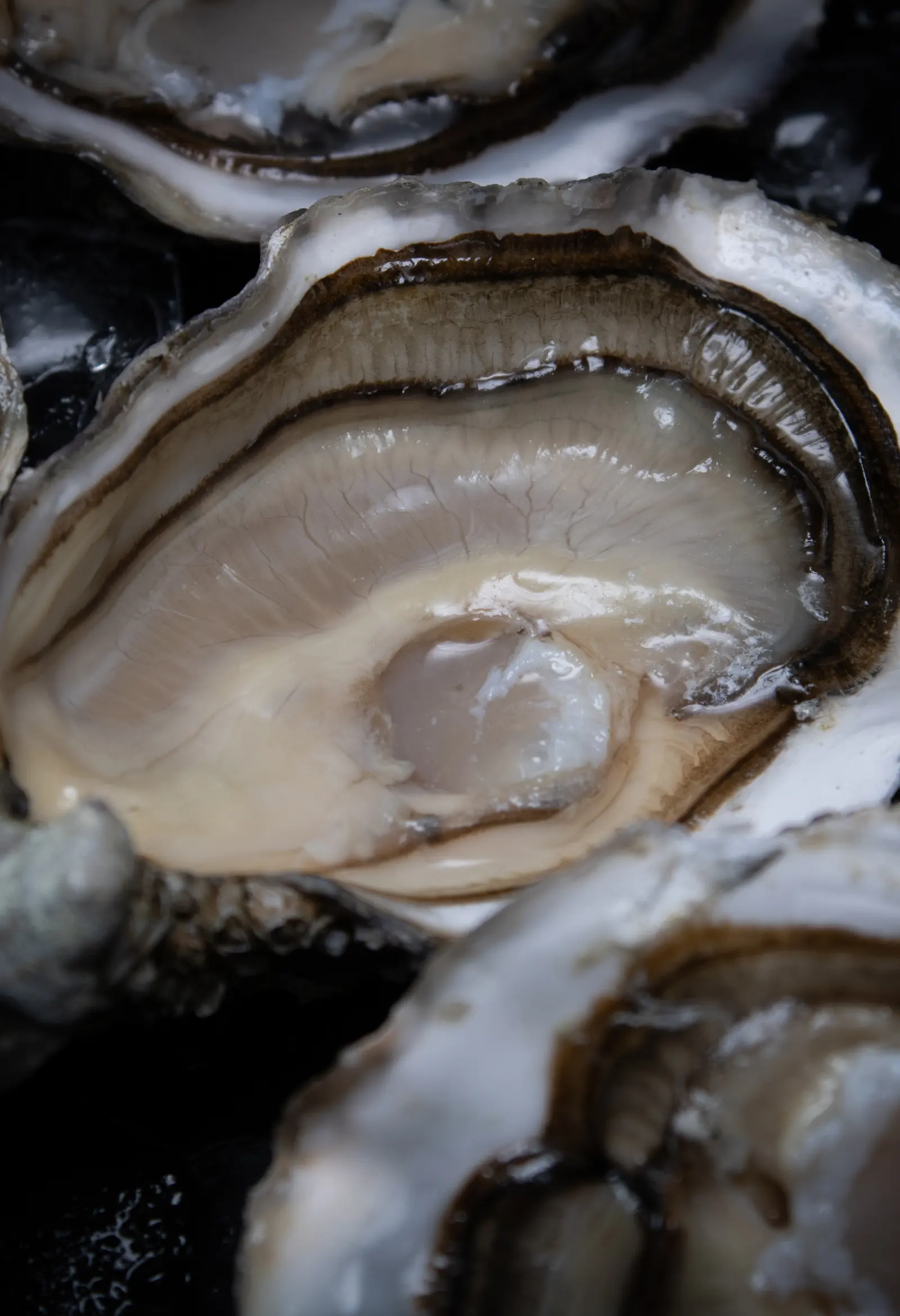
Spéciale, super-spéciale: what the words mean
An oyster is called spéciale when its flesh ratio — the weight of flesh over total weight — exceeds ten per cent; super-spéciale above fifteen per cent.
The calculation, step by step
How the flesh ratio is worked out, in five steps: weigh the whole oyster; take out the flesh and drain it; weigh the drained flesh; divide the flesh weight by the total weight; the resulting ratio gives the grade.
Example: an oyster of 90 g, 6.3 g of drained flesh, giving a flesh ratio of 7%: Fine.
Example: an oyster of 85 g, 10.2 g of drained flesh, giving a flesh ratio of 12%: Spéciale.
Example: an oyster of 80 g, 13.6 g of drained flesh, giving a flesh ratio of 17%: Super-spéciale.
Illustrative values, to show the calculation: they are not measurements by the house.
Example
- 1 · Weigh the whole oyster85 g
- 2 · Take out the flesh and drain it
- 3 · Weigh the drained flesh10.2 g
- 4 · Divide: flesh ÷ total weight10.2 g ÷ 85 g = 12%
- 5 · The ratio gives the gradeFineSpécialeSuper-spéciale
Illustrative values, to show the calculation: they are not measurements by the house.
Fine or spéciale
What you are really paying for
What is the difference between a fine oyster and a spéciale, and why do their prices differ? It is simple logic: what counts is the flesh ratio. For the same weight, a spéciale gives you more to eat than a fine; the rest of the weight is shell and water.
If a spéciale seems expensive to you, it is not necessarily so. Work it out per kilo of flesh rather than per kilo of oysters: divide the price per kilo by the flesh ratio.
Example
A fine oyster
- Price per kilo of oysters
- €12
- Flesh ratio
- 8%
- Flesh in one kilo
- 80 g
Price per kilo of flesh
€150
Super-spéciale
Ostra Regal
- Price per kilo of oysters
- around €28
- Flesh ratio
- 15% to 17%
- Flesh in one kilo
- 150 g to 170 g
Price per kilo of flesh
€165 to €187
Per kilo of oysters, Ostra Regal costs 2.3 times the price of this fine oyster. Per kilo of flesh, the gap falls to 10–24%.
Our Fine de Cancale belongs to the fine category: its flesh ratio is below ten per cent. Ostra Regal is a super-spéciale: every kilo holds roughly twice as much flesh. You pay for what you eat, not for the shell.
The fine oyster in this calculation is an example (€12 per kilo, 8% flesh), not a price survey. The Ostra Regal price is indicative: it varies with size and point of sale.